Re: Re: Re: Una rondine non fa primavera 1
Girmi ha scritto:
Le vendite di macchine (non iPod) sono aumentate parecchio negli ultimi trimestri, soprattutto MacMini che si sta rivelando una bella spinetta nel fianco dei Wintel (pensa la strage di PC di basso livello se erick81 riesce a convincere un po' di gente che sul MacTelMini ci può girare tutto il software Win).
Affermazione falsa e tendenziosa, che travisa le mie intenzioni.
Riporto le mie precedenti affermazioni:
OS X su PC: forse non hai letto bene, anche se in modo incompleto (rosetta non funziona), OS X gira su un Pentium 4 Prescott a 2,8 GHz. Opendarwin è stato utilizzato per rendere possibile la cosa. Magari non funzionerà mai completamente, ma è un fatto che stanno riuscendo a farlo funzionare solo qualche settimana dopo il rilascio dei devkit MACTEL.
Anche questa protezione hw potrebbe però cadere, seppur illegalmente, permettendo di installare OS X su un Dell...
Aspetto ancora notizie del G5 2,7 GHz DP e dell'FSB...visto che utilizza Apple da anni, perchè aspetta a rispondere?!?
Le riporto un mio post, magari le è sfuggito:
In attesa che fornisca motivazioni a questa affermazione
Girmi ha scritto:
Personalmente il fatto che non ci siano ancora i G5 a 3GHz, mi preoccupa poco. Un G5 2,7 GHz DP è ancora il PC più veloce in produzione.
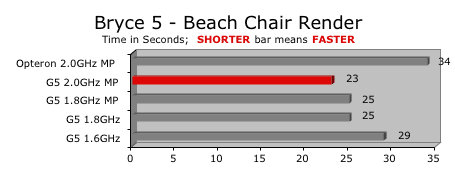
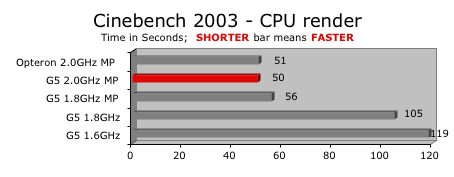
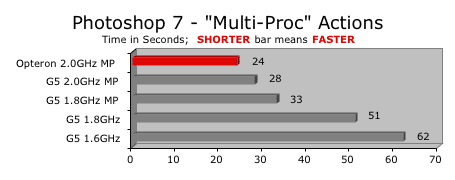
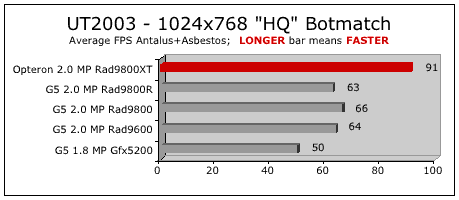
le posto qualche dato (non taroccato da Apple/Veritest):
Se si considera che i bench con Opteron non sono stati realizzati con Windows XP X64 (con il quale sarebbe stato ancora più performante)...
Anche Tiger non è un SO full 64 Bit, comunque.
http://www.computervideo.net/apr04-1.html
Yes, the dual-2GHz G5 PowerMac is the world's coolest PC and also, probably, the most desirable, which is why it deserves our Innovation award. But, it's far from being the fastest, even though it is hugely innovative. Fastest on test here is the Armari-built dual-Opteron - winner of Editor's Choice award - and we believe that AMD's 64-bit CPUs will extend their performance lead over their competitors when a 64-bit operating system, programs and drivers arrive this year.
Preciso che l'Opteron più performante opera a 2,6 GHz, mentre il G5 è disponibile anche a 2,7 GHz. Su una WS dual socket Opteron sono installabili fino a 4 CPU fisiche (dual core), surclassando in maniera imbarazzante una soluzione dual socket Apple.
http://anandtech.com/mac/showdoc.aspx?i=2436 (anand ed xbit sono considerati i siti più affidabili per questo genere di analisi)
The conclusion is that the Opteron has, by far, the best FPU, especially when more complex instructions such a FDIV (divisions) are used. When the code is using something close to the ideal 50% FADD/FSUB and 50% FMUL mix and is optimised for Altivec, the G5 can roll its muscles. The normal FPU is rather mediocre though.
[...]
Povray runs mostly out of the L2- and L1-caches and mimics almost perfectly what we have witnessed in our Flops benchmarks. As long as there are little or no Altivec or SSE-2 optimisations present, the Opteron is by far the fastest CPU. The G5's FPU is still quite a bit better than the one of the Xeon.
[...]
The G5 is capable of competing in one test. Lightwave rendering engine has been meticulously optimised for SSE-2, and the " Netburst" architecture prevails here. We have no idea how much attention the software engineers gave Altivec, but it doesn't seem to be much. This might of course be a result of Apple's small market share.
[...]
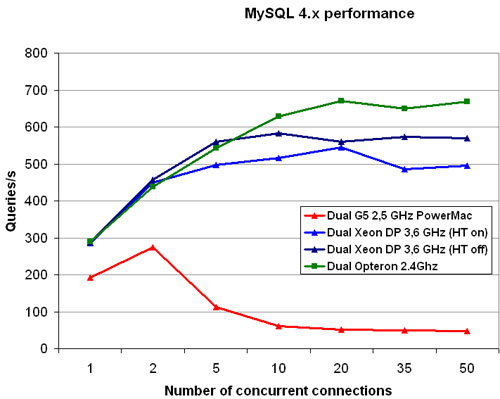
Lascio perdere le penose prestazioni di G5/OS X in ambito server.
Non è stato comunque utilizzato l'Opteron single core più performante (2600 MHz).
Altro giro:
http://www.mediaworkstation.com/articles/viewarticle.jsp?id=25633-1
Visto il vantaggio della soluzione AMD64, anche con un dual Opteron 2,0 GHz (la WS Apple utilizzava comunque 1 GB di RAM in più), le prestazioni sarebbero superiori a quelle del Dual G5 2,0 GHz: in poche parole, clock for clock, l'Opteron è più performante del PPC 970FX.
Ribadisco che (non serve un master per poterlo dire), una WS dual socket con Opteron dual core, surclasserebbe un dual G5 a 2,7 GHz in modo netto e completo. Non è colpa di AMD se IBM produce CPU multicore per i giochini e non per i G5 (a proposito, anche il Nintendo revolution utilizzerà una CPU 970FX derived a 5 core...).
Pertanto la sua affermazione non si può considerare corretta.